

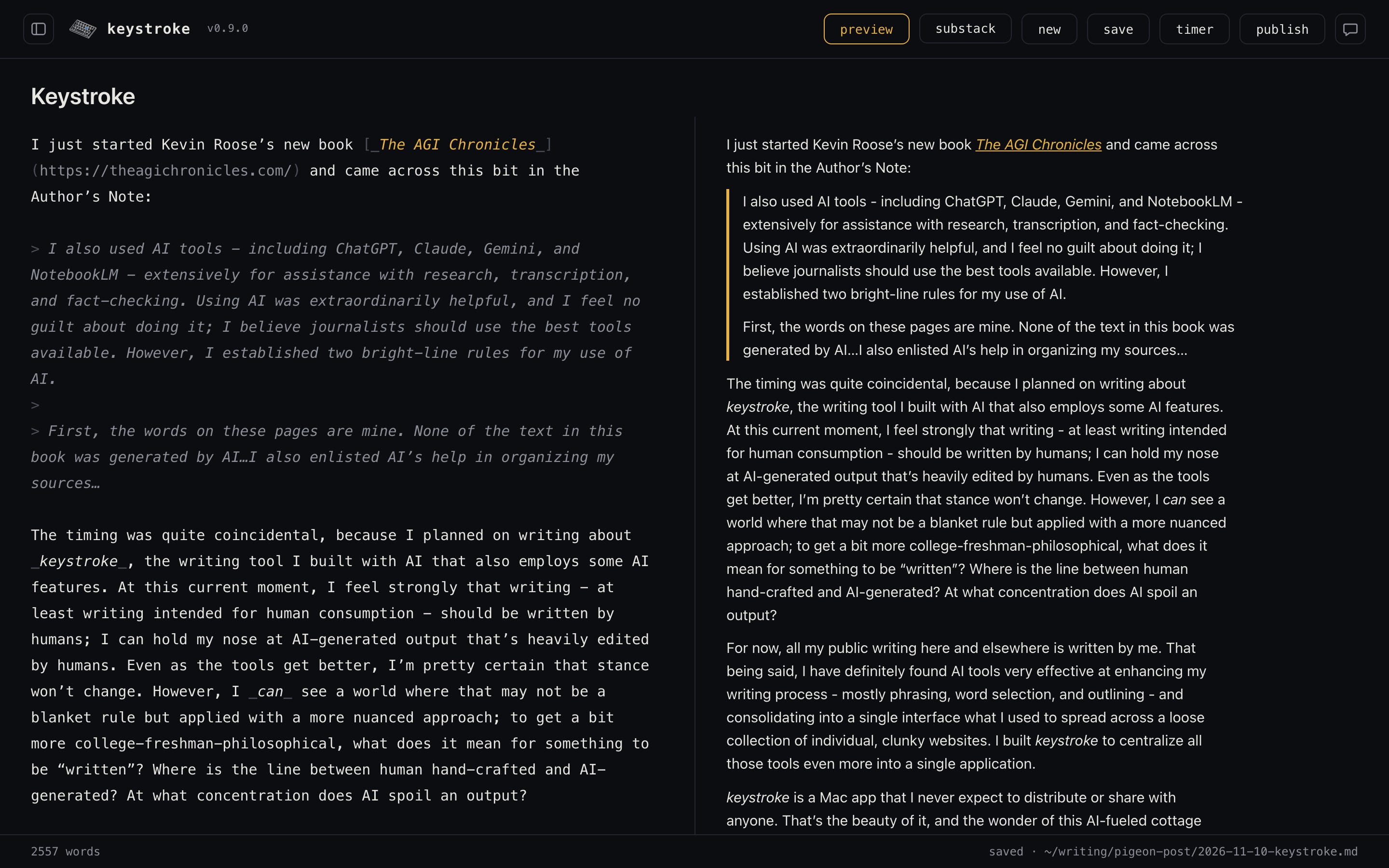
I just started Kevin Roose’s new book The AGI Chronicles and came across this bit in the Author’s Note:
I also used AI tools - including ChatGPT, Claude, Gemini, and NotebookLM - extensively for assistance with research, transcription, and fact-checking. Using AI was extraordinarily helpful, and I feel no guilt about doing it; I believe journalists should use the best tools available. However, I established two bright-line rules for my use of AI.
First, the words on these pages are mine. None of the text in this book was generated by AI…I also enlisted AI’s help in organizing my sources…
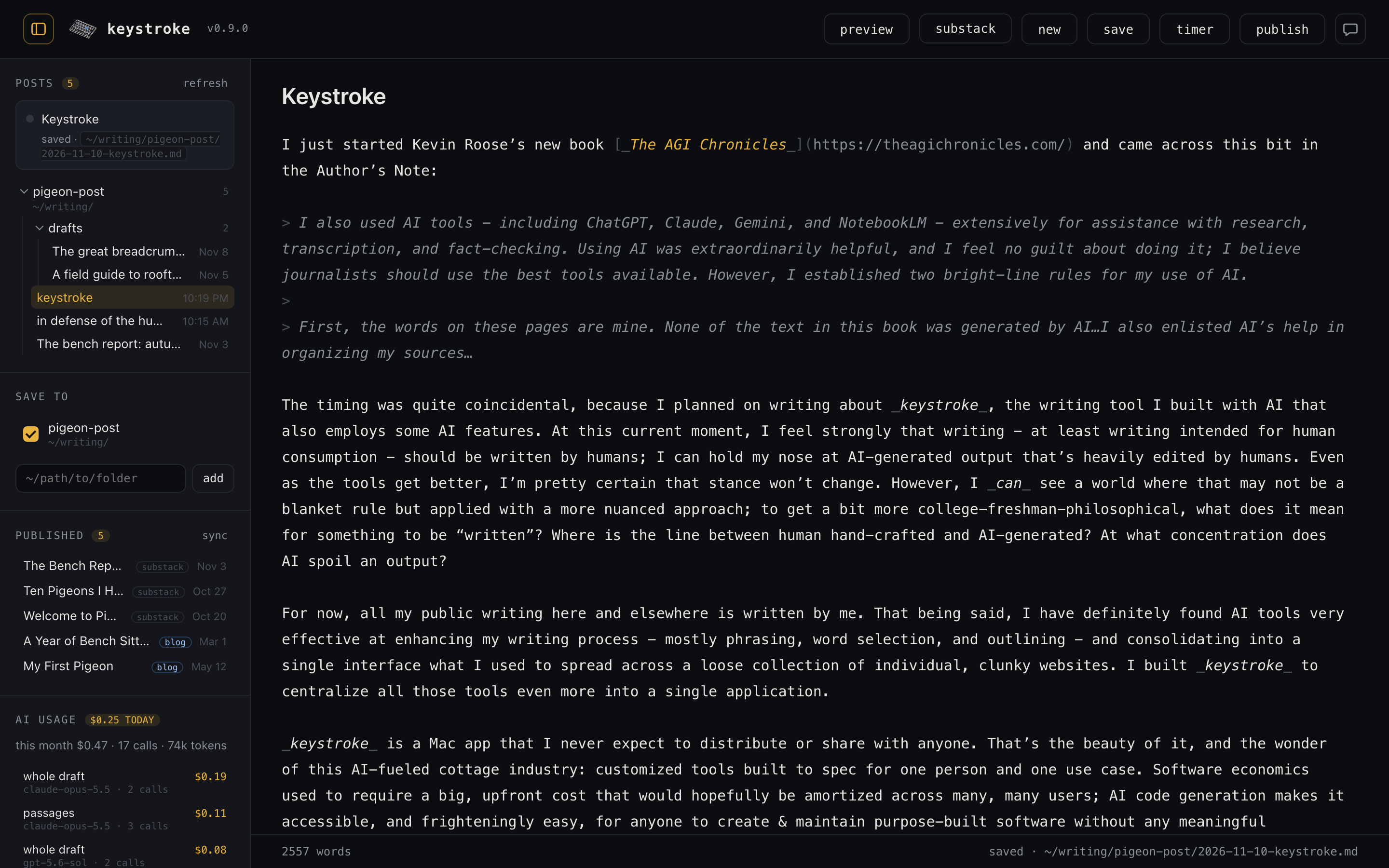
The timing was quite coincidental, because I planned on writing about keystroke, the writing tool I built with AI that also employs some AI features. At this current moment, I feel strongly that writing - at least writing intended for human consumption - should be written by humans; I can hold my nose at AI-generated output that’s heavily edited by humans. Even as the tools get better, I’m pretty certain that stance won’t change. However, I can see a world where that may not be a blanket rule but applied with a more nuanced approach; to get a bit more college-freshman-philosophical, what does it mean for something to be “written”? Where is the line between human hand-crafted and AI-generated? At what concentration does AI spoil an output?
For now, all my public writing here and elsewhere is written by me. That being said, I have definitely found AI tools very effective at enhancing my writing process - mostly phrasing, word selection, and outlining - and consolidating into a single interface what I used to spread across a loose collection of individual, clunky websites. I built keystroke to centralize all those tools even more into a single application.
keystroke is a Mac app that I never expect to distribute or share with anyone. That’s the beauty of it, and the wonder of this AI-fueled cottage industry: customized tools built to spec for one person and one use case. Software economics used to require a big, upfront cost that would hopefully be amortized across many, many users; AI code generation makes it accessible, and frighteningly easy, for anyone to create & maintain purpose-built software without any meaningful commitment of time or energy.
It’s far from being complete - “Software is never finished, only abandoned.” - and its presence undoubtedly will change my writing process over time. It’s built to be a companion for how I currently write, but the presence of a malleable, customizable tool will in turn change what I think is possible for a writing process.
Blogging by hand
I’ve been an infrequent blogger on my own personal website for over a decade. As a programmer, I just wrote with my current default IDE at the time - Notepad++, Eclipse, Sublime Text (2 & 3!), VS Code, Cursor - since that’s what I was comfortable with. The experience using an IDE to write text for reading as opposed to code wasn’t that great, although some of the tools started to include features that would highlight misspelled words and render the Markdown preview which were helpful.
Typically, I’d have an idea rattling around in my brain for some time, and after ruminating on it for long enough would sit down to write. After some labored writing I’d have it to about 70% of where I wanted it - main idea jotted down, no real flow, misspellings. I’d reach for dictionary.com and thesaurus.com, try to remember some pointers from On Writing Well, and hit send. Inevitably, once I saw it on my own website, I realized that something didn’t read quite right or that I had accidentally copied and pasted a sentence to the wrong paragraph, and would push an update.
The whole process was inefficient and usually took a few days; I felt that I couldn’t quite express what I wanted to in the way that I wanted to, and would endlessly tinker to try and tease out the idea in a better way. Writing the first draft was usually straightforward, because it took on an On The Road approach of just spilling out everything I wanted to say. I would then attempt to chip away at the marble block, refining it into something legible. The tools weren’t bad - they were designed for programming, and were doing a serviceable job supporting my writing - but they weren’t designed, let alone optimized, for my writing process.
Panic-driven writing
After a period where I wasn’t writing much, I blamed the process: it was taking too long to get an article across the finish line, and so I was less inclined to transform the idea in my brain into written form. I had built a few projects using AI tooling - nothing noteworthy, as the models were still early, but incredible enough to start imagining the possibilities - and thought that instead of just using my default programming tool to write prose, I could instead build something custom.
My first idea was a pretty coarse one: if it was taking too long to write, why not dangle a Sword of Damocles above me when I was writing? I used Claude to build a very simple text box that came with a timer and a customizable action: when the timer hit triple zeros, the action would execute. My action was that it would post to my blog. The negative incentive was forcing me to write fast, otherwise an embarrassing half-finished article or a jumble of random sentences would be published under my name.
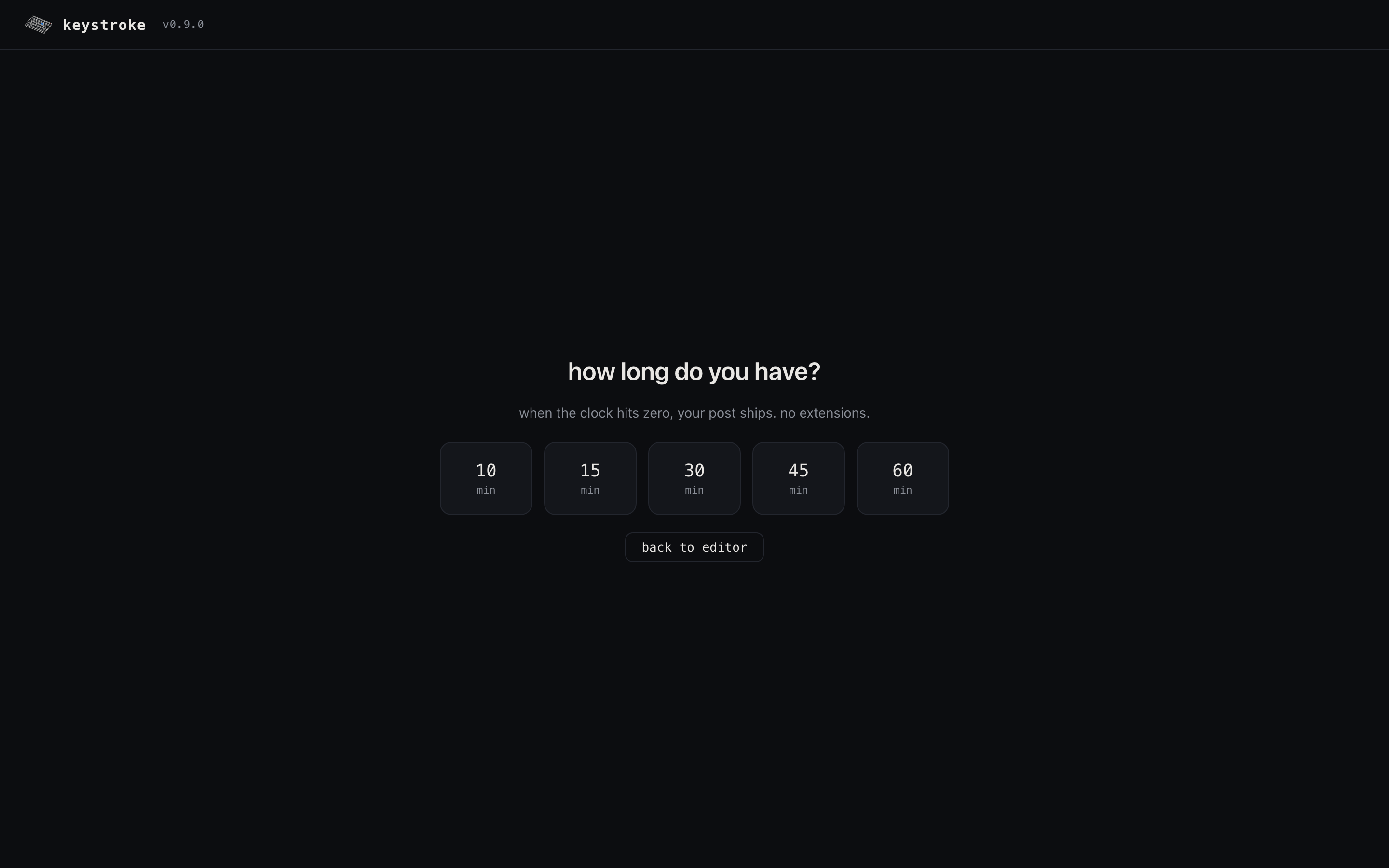
Rather than squander precious time worrying about small details, the time pressure would encourage me to quickly lay out and present my idea in a logical manner, prioritizing the meat of the essay. The thought was that the urgency, with the possibility of public embarrassment, would over time teach me how to write swiftly and with focused intent. It worked a few times, and I was able to churn out some published posts in a fraction of the time.
What was interesting was that my approach to writing was somewhat aligned with the AI tooling: both were allowing me to speed up a process that would typically take meaningful time, so much so that I had to be particular about what to spend that time on. There were many weekend projects I had thought up but never executed on because it would take too much time; similarly, I had many ideas sprouting in my head that never saw the light of day because the process was too cumbersome. AI allowed me to offload the cost of writing the software to a model and just focus on the outcome for those weekend projects. For my writing, I used the AI to influence the process itself to enable my human expression to be more frequent and focused.
After a few runs, it was clear that just forcing myself to write faster wasn’t going to just naturally make writing easier; it certainly shifted my approach, but there were many other steps in the process where time was spent that I figured could be helped.
AI-assisted Writing
AI has helped at multiple levels: theme & organization clarity, sentence & paragraph flow, and word & symbol correctness. keystroke just uses a simple OpenRouter integration to scale up or down models based on the intensity of a task & to allow for better logging and visibility for later analysis.
Theme & Organizational Clarity
This part happens outside of keystroke but I still consider it as all one and the same, since keystroke is just an interface wrapped around one set of steps in a larger process. Eventually, I’ll play around with integrating some of the voice models - the proliferation of options like Dessa is extremely exciting - but honestly the voice chat features OpenAI and Anthropic offer today are already incredibly natural.
While driving or walking - activities that lend themselves to meandering thinking - I’ll use a voice chat to spill out the rough contours of an idea in my head. Talking out loud to a non-judgmental ear is an incredibly helpful process to validate and formulate an idea into something that feels more concrete. While the models can be too obsequious, they do give some critical feedback on the idea. Mostly, they help tease out weak points or contradictions of the argument, or help identify connections between previously disparate ideas. I assumed the voice chat would be a glorified rubber duck, but it surprised me by being a good thought partner, volleying ideas back and forth & providing some constructive criticism.
I’ve said this exists outside of keystroke, and that’s mainly on purpose. I don’t use any of the text from this session that wasn’t already written or spoken by me. Instead, I start with a blank page in keystroke but an overall map for how the post should be segmented and ordered, with a somewhat clear theme and intention.
This initial voice chat step has been such an advantage over my previous approach of stream-of-consciousness writing in an attempt to get everything down on paper. Once I had a pile of words, I’d take a Magnetic Poetry approach until I had some semblance of an outline, and continue to refactor. If it wasn’t clear, this was a laborious process and often still resulted in muddled output. I much prefer this new AI-enabled way.
Sentence & Paragraph Flow
My mental model of writing has been similar to a sculptor working on a piece of stone. There’s a hulk of unrefined idea that needs to be whittled down to its essential, expressing the message in a form both pleasant and striking to the audience. Often, the final result looks closer to an elementary school pottery project than a David, but the intent is still there.
One thing I knew about my own writing, and that the models happily reinforced, was that I tend to be long-winded and verbose. This is probably where I find the tools most helpful - they can identify awkward pacing or placement, and tease out where I might be restating myself across scattered points in the article.
keystroke has a built-in chat window with a main thread where I can get feedback on the overall flow and organization of the piece. I used to do a lot of back and forth with either a Codex, Claude, or ChatGPT chat app session to get the feedback, but the switching back and forth between apps and having the feedback be in text was cumbersome. Now, as a native integration in the app any feedback can be evaluated and incorporated in a first-party way.
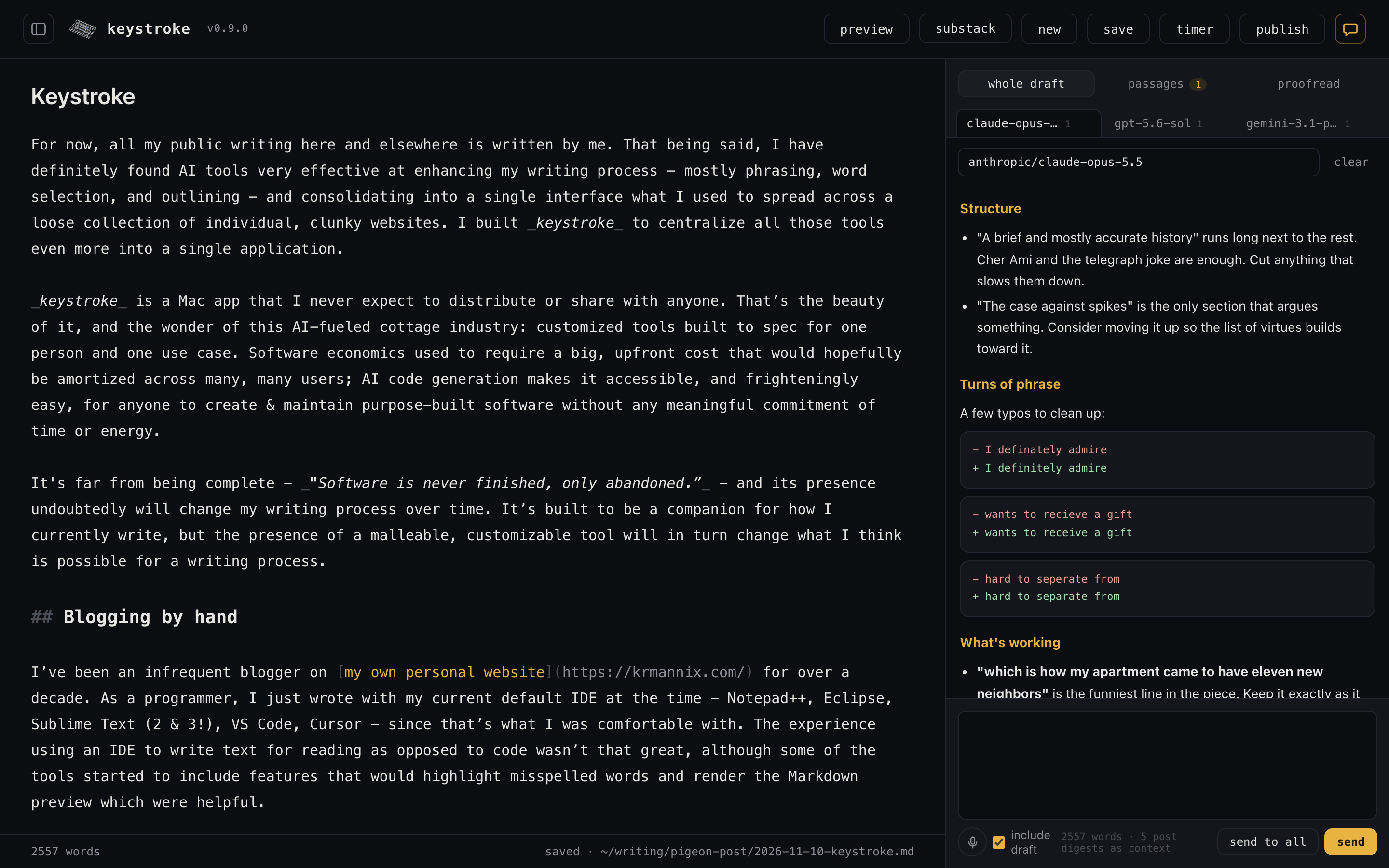
Maintaining a voice through all of this is important, and I have keystroke sync with my blogs and Substack so that it knows my entire corpus of public writing. A background job will process each individually, pulling out the core theme, best lines, and other attributes into a summary. It then includes those in the prompt when calling out to models for help on a piece. There’s likely lots of token optimization to be had here, but I’m still calibrating what’s most helpful.
I can also highlight specific sections and ask for tailored feedback on a specific sentence or paragraph. I can identify my own frequent uses of a run-on sentence, and even just seeing other formats reorganize my words can help inspire a cleaner final output.
I find the tools here elevating what should hopefully be an already concrete theme and direction. The models help in improving the expressiveness and precision, with keystroke facilitating and applying feedback.
Word & Symbol Correctness
The most mechanical of the three: fixing grammatical mistakes and selecting better words.
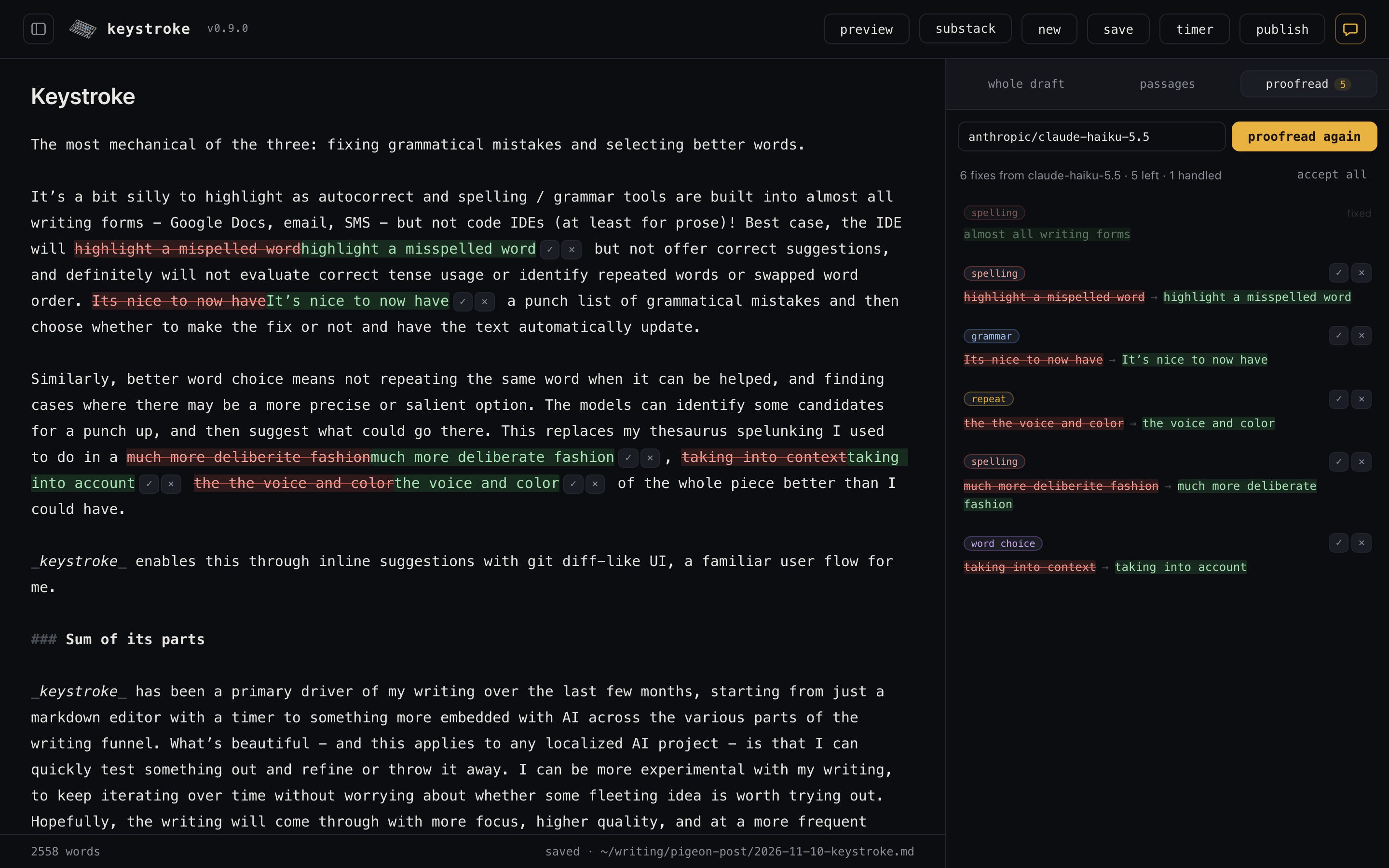
It’s a bit silly to highlight as autocorrect and spelling / grammar tools are built into almost all writing forms - Google Docs, email, SMS - but not code IDEs (at least for prose)! Best case, the IDE will highlight a misspelled word but not offer correct suggestions, and definitely will not evaluate correct tense usage or identify repeated words or swapped word order. It’s nice to now have a punch list of grammatical mistakes and then choose whether to make the fix or not and have the text automatically update.
Similarly, better word choice means not repeating the same word when it can be helped, and finding cases where there may be a more precise or salient option. The models can identify some candidates for a punch up, and then suggest what could go there. This replaces my thesaurus spelunking I used to do in a much more deliberate fashion, taking into context the voice and color of the whole piece better than I could have.
keystroke enables this through inline suggestions with git diff-like UI, a familiar user flow for me.
Sum of its parts
keystroke has been a primary driver of my writing over the last few months, starting from just a markdown editor with a timer to something more embedded with AI across the various parts of the writing funnel. What’s beautiful - and this applies to any localized AI project - is that I can quickly test something out and refine or throw it away. I can be more experimental with my writing, to keep iterating over time without worrying about whether some fleeting idea is worth trying out. Hopefully, the writing will come through with more focus, higher quality, and at a more frequent pace.
Version One
The original intent of this post was to get back to the premise of this series: a show-and-tell of the various little apps and tools and bits of software AI has enabled me to write, that would never exist without the rapid ascent of frontier models. However, a more nascent theme emerged alongside it, one that underlies any conversation around writing and AI: what principles will govern the extent to which AI can aid writing, what we believe to be morally grounded and what society at large might deem acceptable? Is there a difference between using traditional writer’s resources and using AI for those same purposes?
Further still, documenting the evolution of my personalized AI tool revealed how it’s enabled a change in my writing approach. It doesn’t seem too extreme to say that the change in my process has in turn changed how I think through expressing larger themes and ideas. This mutual reinforcing is exciting, but a familiar one that follows the arc of tech adoption: version one assists the existing manual process, which modifies itself to exploit the new technology in response, leading to the next technical iteration building on top of that modification, and so on. We’re so early in AI tools for the general public that most everything is still in that version one mode; personal, customized software can evolve at breakneck speed to form the optimal process-tool symbiosis for that specific individual.
For ten years, I had a process that worked. Clunky, inefficient, but worked. AI provided the raw material and energy to wish up how I really wanted my writing process to work, and then quickly make that a reality. I keep finding ways to improve the process from ideation to finishing touches while staying true to my core belief that something meant for reading by humans should ultimately be written by humans - this post included.